Using fungi and bacteria to clean European contaminated soils

Developing a sustainable, low-impact bioremediation solution for soil decontamination

Reduction of CO2 emissions compared to current methods

Increased biodiversity and ecosystems’ preservation

Validation in pilot sites in Spain and Belgium

LIFE INBIOSOIL AT A GLANCE

A sustainable, replicable and cost-efficient solution to soil pollution

Across Europe, hundreds of thousands of sites are contaminated by long-lasting pollutants that harm ecosystems, water, and human health. Cleaning these soils usually requires excavation or high-energy treatments that are costly and disruptive.

LIFE InBioSoil is developing and demonstrating a new way to clean polluted soils in situ without excavation. The project uses natural biological processes driven by fungi and bacteria that can transform harmful chemicals into harmless substances, helping soils recover their natural balance.

What do we do?

Our goal is to prove that soil can be cleaned directly on site through biological processes. This reduces the need for heavy machinery, avoids waste transport, and helps soils recover their natural balance.

By combining low-pressure injection, mycoremediation, biosurfactants, and predictive functional genomics, the project proves that contaminated soils can be rehabilitated efficiently without excavation or harmful secondary effects. The objectives of the project are to:

Achieve 40–85% degradation of Total Petroleum Hidrocarbons (TPH)

Produce replicable guidelines for other European regions

Reduce greenhouse gas emissions by 80% and energy use by 90% compared to conventional methods

Increase awareness of sustainable soil restoration across Europe

Demonstrate the technology at two pilot sites in Spain and Belgium under different conditions

The challenge

Soil contamination is one of Europe’s biggest hidden problems. When chemicals remain in the ground for decades, they can spread to groundwater, reduce fertility and endanger both wildlife and people.

Traditional clean-up methods are often expensive and require moving or heating large volumes of soil, consuming energy and releasing emissions.

Contributing to the EU Soil Monitoring and Resilience Directive, aiming to achieve 100% of healthy soils in Europe by 2050, LIFE InBioSoil offers an alternative: a biological, in situ solution that treats the soil directly on site, reducing disruption and restoring its natural functions.

"Our mission is to prove that nature itself holds the key to restoring polluted soils. With LIFE InBioSoil, we are combining science and sustainability to give land a second life"
Sònia Jou
LIFE InBioSoil technical coordinator, Eurecat Technology Centre

Why it matters?

Healthy soils are essential for clean water, safe food and biodiversity. Yet soil pollution remains one of Europe’s least visible problems.

By providing a non-destructive, scalable, and circular approach to soil remediation, LIFE InBioSoil directly supports:

EU Soil Strategy for 2030

EU Mission “A Soil Deal for Europe”

European Green Deal and zero pollution objectives

Meet our team

Eurecat

Coordinator, expert in environmental bioremediation technologies

Tecnoambiente

Soil inspection, monitoring and field implementation

Injectis

Developer of low-pressure SPIN® injection systems

Novobiom

Expert in fungal biotechnologies, combines a proprietary strain library with predictive AI to drive industrial-scale fermentation

News & Events

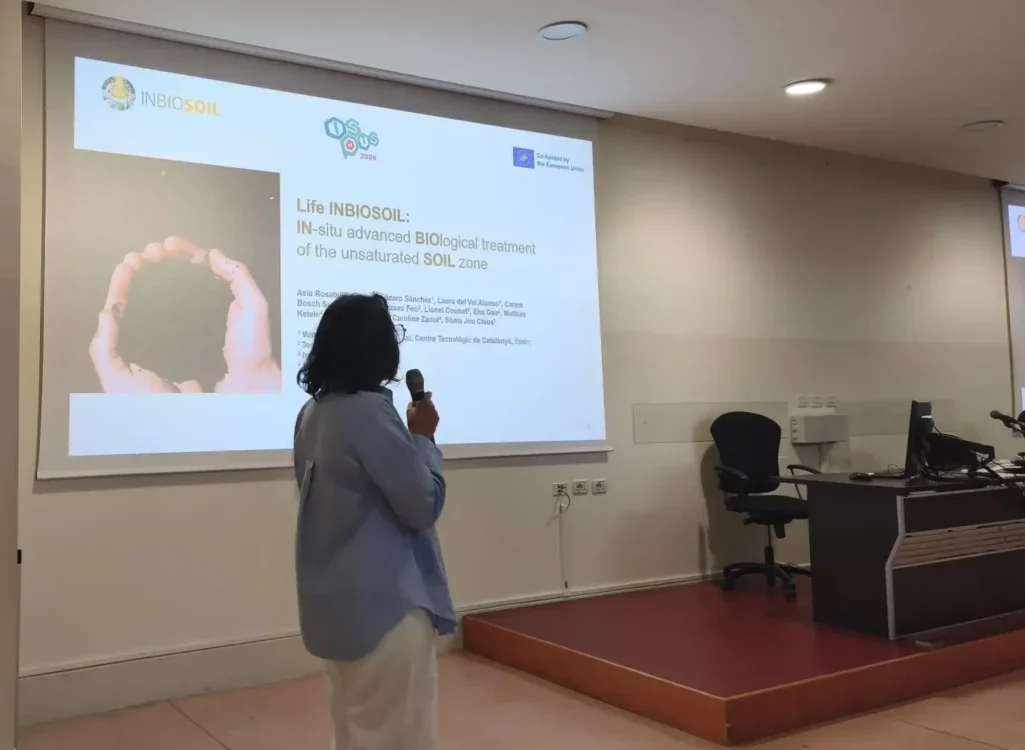
Catalan Conference on Soil Contamination
Eurecat shared key advances in sustainable soil remediation and promoted the InBioSoil project.
The European project LIFE InBioSoil is developing and testing an innovative biological solution that uses microorganisms to achieve an estimated reduction of up to 85 percent of soil contaminants, while cutting greenhouse gas emissions by 80 percent compared to conventional soil remediation methods.
Organised annually by the European Commission through CINEA, this event brings together newly funded projects under the latest LIFE Programme call.

Stay in the loop!

Sign up to our community of interest!

Receive in your inbox periodic content on the project progress and be the first to know about our outcomes.